A Neighbourhood Loop for an Unhurried Morning
Plan a neighbourhood running loop for an unhurried morning, with familiar landmarks, a comfortable return point and room to adjust as you go.
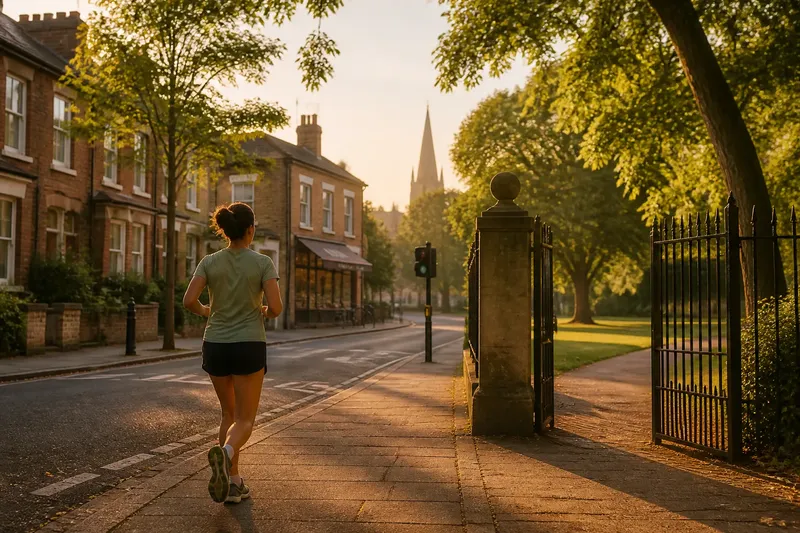
A neighbourhood running loop for an unhurried morning should make the return feel as clear as the departure. Choose a familiar landmark, a route that suits the streets around you, and a nearby point where you can shorten the outing without turning back in a hurry.
The best shape depends on what the morning asks of you. A quiet residential grid, a park edge and a route past busy crossings each call for different choices. Treat the loop as a small local arrangement, not a route you must complete exactly as drawn.
What kind of morning are you planning for?
Start with the conditions you can see and the demands waiting at home. You do not need to predict the whole run; you need a route that remains comfortable if the morning is less settled than expected.
- If the streets are quiet: Use a compact loop through familiar residential roads. It is easy to recognise turns, and you can keep the route close to home.
- If you need a calm setting: Choose a park path or a greenway where the surface and direction are easy to follow. Check that the route has a straightforward way back to your usual streets.
- If you have a firm time to be home: Keep the loop close and build in a clear turning point. A route with several nearby return streets offers more flexibility than one that carries you far from home.
- If the weather looks unsettled: Prefer paved, well-used paths with sheltered sections and more than one way back. Avoid making the farthest point depend on a single exposed stretch.
These are not fixed categories. A route may combine them: a quiet street can lead to a park, then return along a busier road with open shops or transport nearby.
How should landmarks shape the loop?
Pick landmarks that are easy to identify while moving: a library entrance, a distinctive bridge, a playground gate, a row of shops or the corner where a broad pavement begins. Use them as waypoints rather than trying to remember every street name.
A simple sequence can be enough: home to the bakery corner, along the park fence, across at the signal crossing, then back by the community hall. Keep the landmarks in an order that makes sense on the ground. If two turns look alike, choose another reference point.
When a place is likely to be closed early, use its building or sign as a visual marker rather than relying on its opening hours. Likewise, a path beside a school may feel different during drop-off time, so note a quieter parallel street if the pavement becomes crowded.
Where should the easy return point be?
The return point is the place where you can decide to head home without needing to finish the whole circuit. It might be a footbridge, the far gate of a small park, or the end of a familiar stretch of shops. Choose one that is unmistakable and connected to a direct route home.
Say you have a short window before breakfast and a local park sits several streets away. You could make the park’s north gate the planned return point, then loop around the paths only if the morning feels settled. The observable result is a route with a known exit: from the gate, you can head straight home or continue around the park before returning.
Make the point useful, not symbolic. A distant landmark that leaves you with a long, awkward walk home is a poor choice for an easy morning. The return should still feel simple if you are ready to stop earlier than expected.
Which local route fits your surroundings?
Is a small street grid a good choice?
Yes, if the pavements are continuous and the crossings are straightforward. A grid gives you several ways to shorten or lengthen the loop, though busy junctions may make a quiet-looking route less restful.
Should you use a park path?
A park can offer a calmer setting and clear visual boundaries. Check for gates, shared paths and sections that lead away from a direct exit, then keep a street-side return available.
What if the route crosses a main road?
Choose a controlled crossing with a clear view and avoid making it the only way home. If the crossing feels hurried or crowded in the morning, use a route that stays on one side instead.
Can the same loop work on different mornings?
It can, provided you allow for changing foot traffic, weather and access. Keep a nearby alternative in mind, such as a parallel street or a shorter park circuit, so the route remains adaptable.
How can the loop stay calm without becoming rigid?
Think of the route as a set of options: an outward stretch, a familiar landmark, and a return that can begin from more than one point. That is enough structure to avoid aimless turns while leaving room to respond to a blocked path or a busy pavement.
Before setting out, glance at the route on a local map if you are unsure how streets connect. On the ground, trust visible signs and crossings over a line on a screen; a map may not show temporary works, closed gates or a path that feels uncomfortable at that hour. Local access rules and any posted path instructions take precedence.
Keep the route close enough to feel ordinary. A familiar loop can make a morning easier to begin because you are not making a fresh navigation decision at every corner. That does not mean every run must follow the same line: changing one street or using a different park entrance can keep the route useful without making it complicated.
For a neighbourhood running loop on a calm morning, the most useful detail is often the easiest way home. Choose landmarks you can recognise, place a sensible return point before the route feels remote, and let the rest of the circuit remain optional. A good local loop leaves you with a clear direction back and no need to rush the morning.