Before the Stopwatch: How Runners Kept Time
How runners kept time before modern watches, from shared signals to stopwatches, course clocks and pacers, and what each could tell a runner.
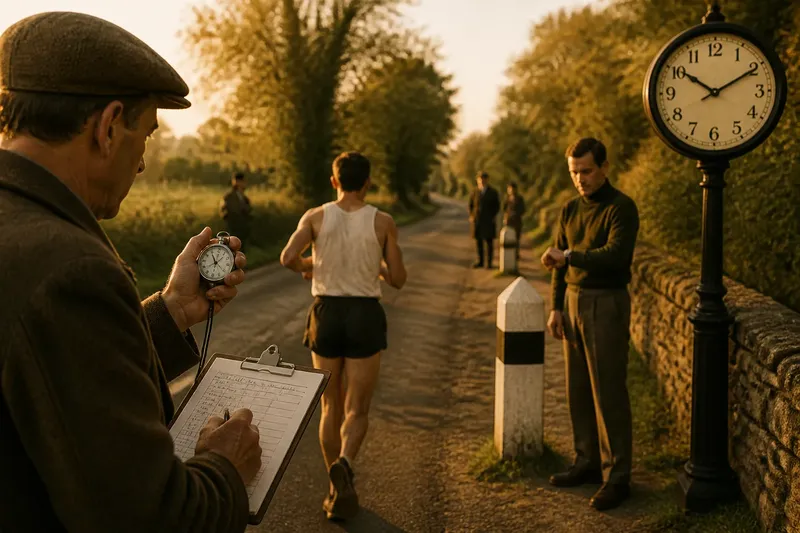
Before a watch could travel on a runner’s wrist, a church bell or a clock at the finish could mark an outing’s beginning or end. How runners kept time depended on what was available nearby: a shared signal, a human timekeeper, a course marker or, later, a personal stopwatch.
How did runners know when to start?
In an organised race, a starter’s pistol, flag, horn or bell gave everyone a common cue. Runners needed to begin together, and officials needed a clear moment from which to judge the result.
Outside races, a church bell or town clock could help place a run within the day. Such a signal might not tell someone the exact duration, but it could mark a departure or a return. For an ordinary outing, that could be enough.
A runner on an open road could not glance at a wall clock. Before small personal timepieces were convenient to carry, keeping time often relied on someone or something stationary: a public clock, a signal or a person waiting at the course.
What did the stopwatch change?
A stopwatch made elapsed time portable. A timekeeper could start it at a race’s beginning and stop it when a runner finished, then write down the result. That record preserved a fleeting performance for later comparison.
Stopwatches could be used by officials, coaches, spectators or runners themselves; who held one depended on the occasion and the available equipment. In a race, a person at the finish might connect a time to a runner’s name or number. A runner could also operate a watch to time an outing or an interval.
A mechanical stopwatch offered a more direct reading of an interval than counting aloud or estimating from a distant clock. The result still depended on human judgement: someone had to decide when to start and stop it. The instrument recorded those decisions; it did not make them.
How did course clocks and mile markers help?
A clock at a track or finish area made elapsed time visible to runners and spectators. On a track, where the course is fixed and repeated, a clock could give a runner context for each lap without requiring a watch.
A finish clock gave the overall time, but not necessarily the duration of each section. Course markers supplied reference points. A timekeeper near a marker could record a passing time, while a runner could use the marker to recognise progress along the route.
Timing information was often shared across people and places. A runner might see a finish clock, while an official’s notes recorded intermediate times. The whole account did not have to sit on one wrist.
Why did pacers become moving clocks?
A pacer offered a human reference for rhythm. Rather than calculate every interval, runners could follow a person maintaining a chosen pace. In a race, an experienced runner might lead a group for part of the event.
A pacer did not display elapsed minutes. Instead, the group could use footfall, posture and position as cues between clock checks. A coach or official might compare that movement with a time at a course marker.
Say a runner in an invented club race has no watch and wants to avoid setting off too quickly. They settle behind a volunteer pacer, then check the official clock at a course marker. The observable result is a shared sense of rhythm between checks, not a personal record of every passing minute.
How did runners time themselves before digital watches?
A wristwatch or compact stopwatch let a runner start timing at departure and stop at the return. A chronograph, a watch with a stopwatch function, could time an interval while still showing the time of day.
A watch could record elapsed time without explaining distance, route or effort on each section. Runners might fill in some of that context from memory and landmarks: a bridge, a turn, a track lap or a change in road surface.
On a familiar circuit, repeated landmarks could give an outing a shape even without a written split for every lap. That method depended on knowing the route; it did not mean each lap had taken the same time.
What are splits, and what can they tell you?
A split is the time taken for one part of a run, such as a lap or marked section. It turns a single finish time into a sequence of observations. A timekeeper can record a passing time, or a runner can mark a lap with a watch’s lap function.
On a track, lap counts and a timing board can help keep a record in order. On a road, course markers and attentive timekeepers provide reference points. The notes may show a change in rhythm, but they cannot explain its cause: wind, terrain, crowding or a tactical choice may all matter.
How do manual and automatic race timing differ?
Manual timing relies on a person operating a stopwatch. It is portable, but the recorded instant depends on the timekeeper’s reaction and on clear procedures. Organisers may use more than one timekeeper or other checks when a result is close.
Automatic systems can record a finish using equipment such as a photo-finish camera or an electronic mat. These tools shift some of the recording work from a person pressing a button to equipment detecting a crossing. They can help organisers distinguish close finishes and record results consistently.
Neither approach removes the need to define the start, finish and course clearly. Technology changes how an instant is recorded; organisers still have to decide what the race’s boundaries are.
What do runners ask about keeping time before watches?
Could runners keep time without carrying a watch?
Yes. A public clock, bell, course marker, pacer or timekeeper could provide a shared reference. These methods might give a runner a start cue or a passing time rather than a continuous personal record.
How did a runner know their elapsed time?
A runner could use a watch, or someone else could time the outing with a stopwatch. Without either, a public clock or familiar signal might indicate an approximate interval, depending on what was available.
What was a split in a race?
A split recorded the time for one section, such as a lap or marked stretch. Officials could note passing times, while runners with a lap function could mark sections themselves.
Did pacers tell runners the exact time?
No. A pacer gave runners a moving reference for rhythm and position, not a readout of elapsed minutes. A clock or timekeeper could provide the timing context at a marker or finish.
What did running watches and GPS add?
Digital running watches brought elapsed time, lap marking and stored results together on a wearable device. A runner could review a run afterwards and, on some models, mark segments without relying on a spectator.
GPS-enabled watches added an estimate of position and distance, allowing runners to view time alongside a route trace and calculated pace. Buildings, trees and route shape can affect positioning, and a watch’s recording settings influence what it stores.
The change was not simply from inaccurate old tools to perfect new ones. Bells and clocks offered shared cues; stopwatches isolated an interval; GPS watches linked time with an electronic account of place. Each answered a different question.
Which older timing tools still matter?
Public clocks, course markers, lap boards, pacers and hand-held stopwatches can still provide a common reference. A coach can call a split at a track, an official can record a finish, and a runner can recognise progress at a marked point without checking a screen.
These tools show that running time has always been both personal and shared. A watch can tell one runner how long an outing took; a start signal, marker or pacer gives people nearby a point of reference in common.
To understand how runners kept time before modern watches, look at what each method could offer: a signal to begin, a marker along the way or a record at the finish. A useful distinction remains today: a clock measures an interval, while landmarks and other people help explain where that interval belongs in the run.